


Written by: Dave Cantrell
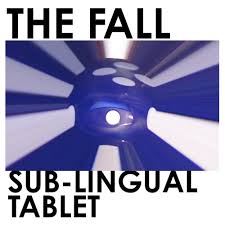
How the hell do you review a new Fall album? More to the point, what’s the point? As the mighty MES of a man has himself said, him with your granny on bongos and kazoo (I paraphrase for effect) would still constitute the Fall. So even though the band as it stands now here on Sub-Lingual Tablet is the longest-serving in decades – which, surely, must make them the most understandably nervous musicians in existence – and the record itself stands as one of their strongest this millennium, it’s still, in essence, ‘just’ another Fall album, i.e. a grumbling grinch of a willful semi-genius rasping at the helm of a lurching craft that sails the gnarled jagged waves of a lingeringly singular post-punk sea they claimed as their own nearly forty years ago. Just, in other words, another shot across the bow from an HMS Endurance which none of us would have bet on back in those wonderfully dark old days of hand-drawn maps and xeroxed zines, days that mapped an adventurous new territory and that, out of that original class of navigators, only this one captain still dares traverse.
There is the expected impeccable intransigence, the clutch of song titles that pull the devoted straight in with wry smiles and knowing nods of head (“Auto Chip 2014-2016,” “Quit iPhone,” and the zinger “Fibre Book Troll”), those damn barely intelligible lyrics that seem generated by a machine stuck on ‘automatic enigmatic,’ (“I can make out A) a reversed white acrylic, lower Urals question mark”) and of course the challenging but still primal urban avant-a-billy music itself, that Beefheart caveman beat known most broadly as ‘the Fall sound,’ a sound we’d call sui generis if applying such a studenty French phrase to the Fall didn’t somehow feel unseemly, a betrayal of sorts. All of that is present, and present in a sharpened, vigorous way that belies any and all reservations anyone could have about this band, be they based in their leader’s age, the band’s overall fuck-off attitude, or whatever form of perpetual bias.
So, there, I’ve more or less reviewed the new Fall album. I mean, I could mention how opening track “Venice With the Girls” churtles along with crisp under-textures and more verve and snap than has been made by any band with a front man over 50 probably ever, that “Dedication Not Medication” will have you tearing your house apart for that deluxe edition of Perverted By Language that never actually came out to see if this is actually a reworked outtake from back then, how the Stranglers will absolutely give it up for good should they hear the insanely tight but untamed growl and bass kill of “Stout Man” or that the aforementioned “Fibre Book Troll” sounds like Can sucked into the fearsome fourth dimension of punk-prog hell (and which also proves inarguably that no one more resembles a troll when shout-singing the word ‘troll’ than Mark E Smith), but really what, again, would be the point?
Look, I…oh for fuck’s sake. Sub-Lingual Tablet is a monster record, OK? Exceeds your wildest wishes for the band in this year of our hex sinister lord 2015. Just buy it already and quit your dithering.
https://www.youtube.com/watch?v=_e7haJ0ITak

As I keep saying, it’s coming from everywhere and it’s hitting without cease. Hailing from Nennes, France, The Insight, while drawing in places from their country’s coldwave heritage, slot, with a neat geographic logic, between the more epic-leaning post-punk of Spain (Barcelona’s October People, for instance) and the darker, heavier, more apocalyptic tones of the mostly Cyrillic-named bands flourishing throughout the former Soviet Union, resulting in a record that careens with seamless ease from the indie-tinged to trespassing without fear into the gothic shadowlands, proving The Insight to be, if nothing else, historically adept at their craft. They’re also bursting with it. White Noise – scheduled for release on Swiss Dark Nights September 25th – spans 71 minutes with nary a moment of filler, The Insight covering their broad spectrum with an unstinting confidence.
How confident? They open the album with a near ten-minute quasi-psych opus called “One Eyed Jack” that’s as much Echo & the Bunnymen tackling a Gallic take on a Sergio Leone soundtrack as anything, all shimmers and shivers and continental yearning, thereby bypassing the dictate that one’s first track should be some sort of boisterous ripper that grabs the listener via sheer audio force. As if to double down, the band end White Noise with two more lengthy outings (the thrumming expansive dirge “The Field” and the lighter, if more morose, Simple Minds-touched “6 Feet Under” that’s the only instance here where a touch of editing might not have gone misplaced), suggesting The Insight are more interested in playing the long game than simply going for the immediate visceral. Though, if it’s visceral you’re looking for White Noise ain’t exactly lacking.
“Give Me A Chance” goes from silver dream to chiming and thunderous in under forty seconds, “Lost Souls” goes for the jugular right off then spends the rest of its running time going for a succession of more jugulars, “Waiting For the Rain”‘s bass-led thrill ride hurtles along with melodic tremors as if it’s got doom on its tail (though, like most of this album, sung in accented English, it’s a romantic doom), while “War” lowers a rhythmic boom and drone like it’s carrying the caisson for Atlas himself. For a combination of the record’s two primary settings – the extended cinematic jam and the more adrenalized jolt – try “Falling Down,” a mid-album cut that also eclipses the 7-minute mark as it wanders from slightly lugubrious ballad to a kind of fog-enshrouded anthem of the heart, gripped the entire time by a persistent moodiness and a near-Wagnerian bottom end.
While on the one hand it might be argued that White Noise could use the deft touch of an editor’s pen here and there, on the other, reining in a band like this scuttles the point. The Insight, by every indication here, are fairly fearless and in the end one wholly endorses their vision – and version – of how an album can sound these days. Whether one skips the longer tracks or gets lost in them – my guess is you’ll fall into the latter category – it’s nothing less than necessary that we be offered albums where we have that choice. In that sense, White Noise is a classic ‘rock’ album that just happens to live in our neighborhood. I way ‘Welcome,’ with a capital ‘W.’

Frankly, any band that begins their debut with a sharp, rumbling, faithful but personal rendition of iconic Clock DVA track “4 Hours” will already find itself firmly embedded in my good graces. Known by many but not nearly as well-known as it justly should be, Lust Era’s decision to launch their LP calling card – there have been many singles and EPs previous – by resurrecting the Sheffield noiseniks’ most cited contribution to the post-punk canon warms the heart and sets the stylistic table for the nine startlingly good originals that succeed it (there are, for accuracy’s sake, three remixes included here). So good is the subsequent material, in fact, that it somewhat overshadows the significant rarity of Lust Era’s Puerto Rican citizenship. Certainly the first from that island territory to appear in this column, they’re also likely the last, at least for a while. When asked by your eager correspondent in a brief Facebook conversation if there was a scene in San Juan, the smile behind the ‘No, not really’ was almost visible.
Clearly using the shard-infested, jagged and obliquely industrial pop of the Adi Newton-stamped brand as their template, the band nonetheless put it to extraordinary use. “A Thousand Rainless Years” bursts forth with the force of the Professionals before settling into a throaty synth-rhythm groove and the singer’s dark baritone emerges from its stentorian shadows, the Bela Lugosi’d gothness of it adroitly balanced by the pure rock’n’roll suss swirling around it. “We Are Alone” builds itself on a motorik factory pulse and a ceiling-scraping, rough-edged but gleaming metallic guitar tone – a wonderfully predominant feature on The Lost Art of Murder and thank the fates – the lonely and soulful “Eating Lead Again” shows the band handle yearning as adeptly as alienation, “Shoots and Ladders” makes persistent gloom utterly irresistible, the bass and drums here like it’s “A Forest” on fire, the guitar, again, a glory of post-punk riffery that’s somehow both delicate and ruthless, like Chris Spedding appearing with Killing Joke.
Perhaps it’s something to do with their comparative remoteness but there’s a hunger and freshness brought to the revivalist tropes on TLAOM that marks Lust Era out. Even on the briefer tracks – the quick dizzy spinaround of “Baila Conmigo” and the trouncing despair of “How Long Until” – a sense of breadth permeates. They own their influences, devour them and become a whole new phenomenon in the process. “Tyrant,” the record’s last track proper (a sprightly remix of same follows it) takes the essence of all that’s been said previous and, in Lust Era’s one nod to their tropical home, allows a taste of salsa shake into it. The result, when added to the standing menu of immaculately dark vintage flavorings, is exhilarating.
Though I can’t, in all honesty, declare this the post-punk debut of the year – there are simply too many competing for the title and ain’t that grand – The Lost Art of Murder certainly deserves the honor of being considered. Bravo!
[The Lost Art of Murder available here]

