

Written by: Dave Cantrell
So much seems to depend on when one becomes interested then intrigued then all but fucking obsessed by the music one encounters as the flourish of (usually teenaged) consciousness expands at a pace that runs hand in sweating hand with the seemingly boundless expanses as that particular field of cultural curiosity opens itself up upon the multiple layers of artistic expression that, reaching back several generations, continues to thrive despite whatever slew of distraction gets thrown in its path (personally it’s among this life’s most stubborn and enduring mysteries that the vast percentage of people – those, that is, growing up amidst a culture riven through with layers of often breathtaking literature and cinema and art in general stretching back centuries and still stubbornly thriving to this day – exhibit zero curiosity in the bounties surrounding them every conscious minute but I digress). For this particular music addict that period of epiphany struck, as it most commonly does, in my mid-teens and as that moment happened to coincide with the early 70s, well, yeah, that was a stroke of fate’s luck the significance of which is never lost on me.
Point of all this? Well, by the late 70s I’d ditched UC Berkeley – like an art degree was going to get me anywhere I wanted to be seeing as 2/3 of those procuring such end up in advertising – and managed at the age of 21 to cadge a job at a one-stop (a warehouse like any other but one distributing product to independent record stores throughout the West Coast region of the US) where, no surprise, I was surrounded by other music obsessives, all with their own unique perspectives genre-wise and thus my true education began. Hence did the day come when someone strolled to the turntable – huge speakers up on the south wall of the place and everyone got their turn – and put on an early promo of Fourth World, Vol.1 – Possible Musics, one of the earliest of Brian Eno’s ambient outings on which he partnered with one Jon Hassell on muted, sinuous, beguiling and mysterious trumpet and something very closely akin to a spell fell upon a number of us as we milled about the stacks pulling orders, our heads in the proverbial – if sharply intriguing – clouds and as that spell unspooled that afternoon its effect, as was frequently the case with pretty much the entire spectrum of non-mainstream picks from the majority of my fellow employees – deepest thanks to Berigan Taylor (among others) for my true intro to jazz, Len Paterson for the occasionally shizoid outré etc, Roger Gilbert for the funk et al and god damn if that list doesn’t persist almost ad infinitum – was something akin to shape-shifting only the shape being shifted was, once again, that precious non-more-amorphous cargo called ‘consciousness’ and in the end, if we’re honest, that’s ultimately what we’re all here for in the first place. It’s the ‘deal with the devil’ that far FAR overshadows anything offered by the other more ‘celestial’ side and by god if said ‘dark’ side hasn’t led me closer to actually ‘seeing God’ than anything the mainstream could ever hope to offer at which point, all said, we move on to the subtly epiphanous world that Mr Hassell didn’t simply trek through throughout his creative life – he passed in 2021 at the age of 84 – but seemed to almost single-handedly conjure into existence in the first place.
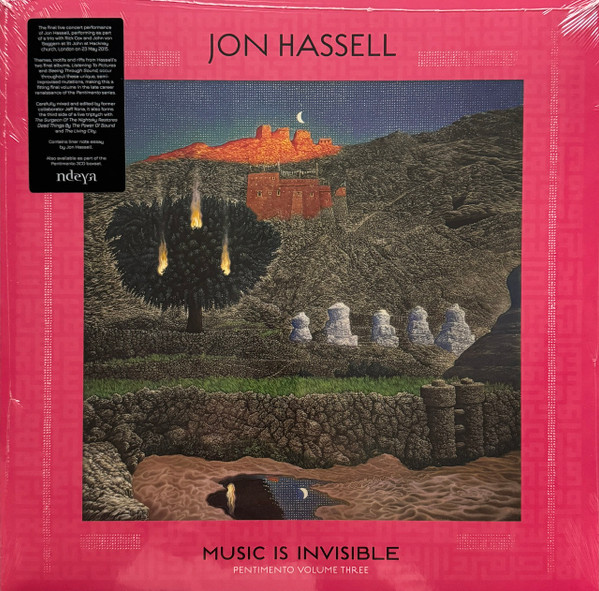
Recorded live – for the last time, as it turned out – at Hackney Church in London in May 2015 with the accompaniment of Rick Cox (guitar, synth, electronics) and John Van Seegern (bass, drums, electronics), Music is Invisible serves as the third and final chapter of Hassell’s Pentimento series, preceded by Listening to Pictures in 2018 and Seeing Through Sound in 2020 which, given those dates, puts his then age at 81 and 83 respectively (and doesn’t even include either of 2023’s posthumous releases The Living City and Psychogeography) which suggests to us that what we’re dealing with here aside from the nothing-less-than-extraordinary work itself on this most recent release, is perhaps the example of an artist embodying his art the the exclusion all else down to his very last breath which in turn cannot but serve as an inspiration nonpareil for any of us applying our energies to the creative life no matter how thickly the stack of calendar pages keep piling up behind us. That alone is a gift just about beyond reckoning but add to that what’s actually on offer here and one is potentially left that kind of speechless that surpasses any actually spoken accolades but as that’s our role here, well…
Emerging as if in fresh descent from the vaunted ecclesiastical vaults looming silently overhead, “Blue Ba-Ya” in its eleven transfixing minutes almost rather palpably raises one’s consciousness with what might well be called an accrual of burgeoning subtlety, Hassell’s trumpet lending the piece an ache of yearning that carries with it a wash of cinematic atmospherics bracketed inside a surround of effects that amounts to something of a pulsar made of sound and implication. It is beautiful, it is transfixing, it is Jon Hassell audibly appearing as a shroud immemorial which is to say it’s what anyone even half familiar with his work would expect and yet it astonishes but then again of course it does, just as the album entire does.
From “Club Gris-Gris,” the Cajun implications in its title carried forward by both the ghostly persistence of Hassell’s trumpet as it seemingly echoes from the darkest corners of a bayou-bordering haunted house while the effects surrounding keep the edges suitably on edge, the result a thing of unsettling beauty; through the coyly entitled “Broadway Boogie-Woogie” that, fittingly, rides a restless undercurrent that’s both what might be termed ‘avant-playful’ and evasively transfixing if that’s even possible which by the evidence here apparently is, to the lengthy finale “Electric Forest” that throughout its sixteen minutes and change not only doesn’t cede an inch of stirringly nuanced ground but as codas go matches up seconds and minutes to the subtly breathtaking jewels of aural fascination that have preceded it.
There is in this curtain call swan song a flow of grace unsurpassable that is both inevitably and counter-intuitively balanced by a creative daring that has always underscored Hassell’s work. While unknown to us whether this is indeed a ‘swan song’ in terms of what may be still forthcoming from the Hassellian cellars, should it serve as such it’s on the one hand hard to believe anything could surpass it while on the other we won’t, shall we say, hold our breath that that wouldn’t indeed be the case. In any, umm, case…
Music may indeed be invisible but so are emotions and silent wonderment and the complex subtleties of our consciousness including love and hurt and joy and, ultimately, just the fundamental act of being alive. This album nestles among those none-more-essential pockets of existence like it was born there and who’s to say it wasn’t.
[find a copy of Music is Invisible here]